
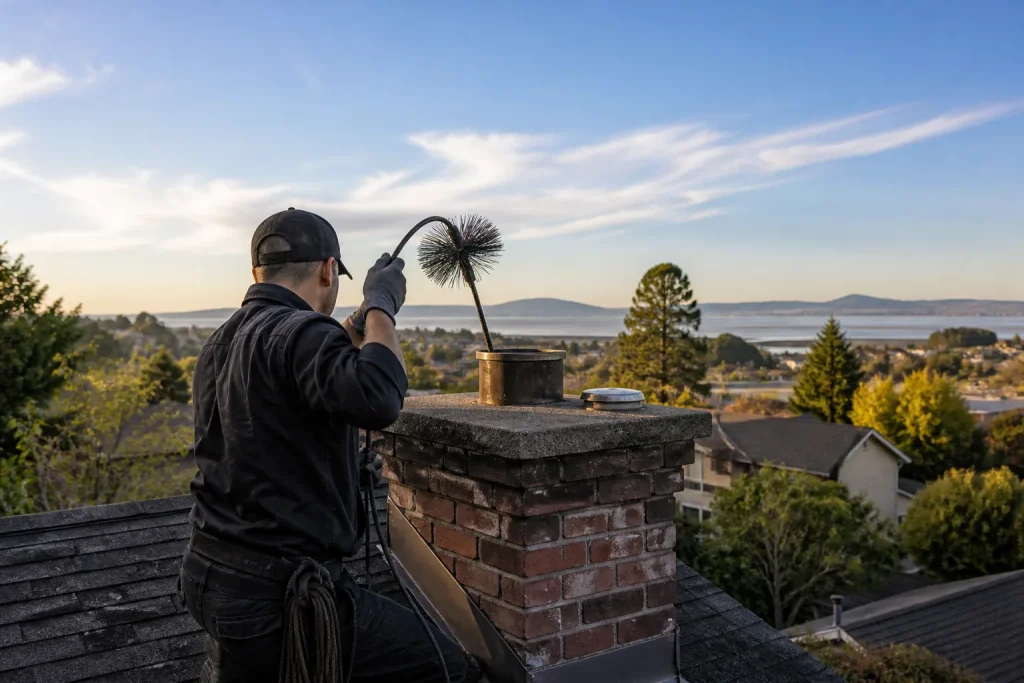
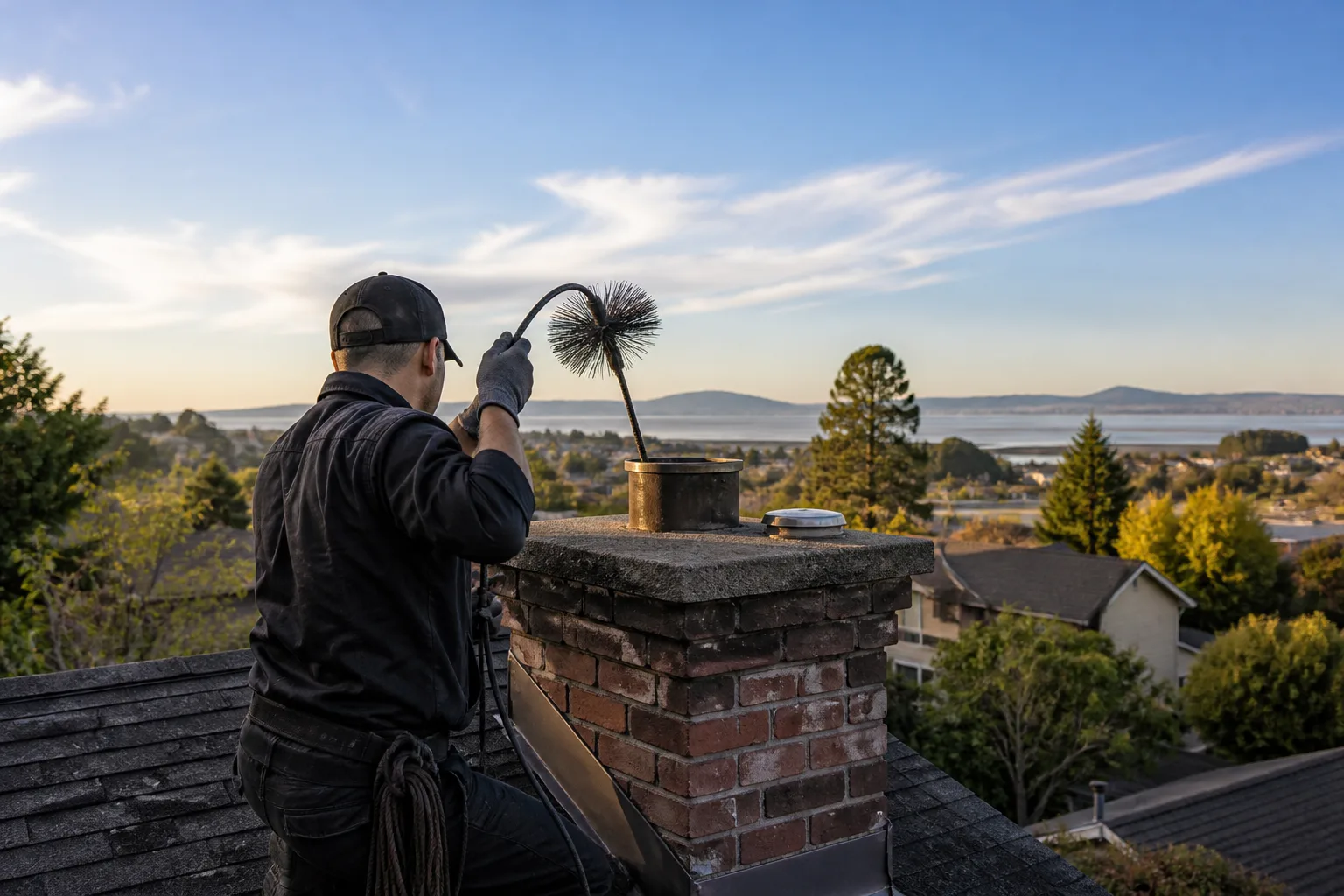
Gelco Chimney Sweep in San Carlos: A Homeowner’s Guide
Gelco manufactures some of the most precisely engineered stainless steel chimney components on the market, and their factory warranties are legitimate. But here’s what most San Carlos homeowners never find out until it’s too late: that warranty only holds if the installer followed Gelco’s clearance, connector, and termination specs to the letter. We regularly see Gelco systems on the Peninsula that were installed with the wrong cap, the wrong connector angle, or missing insulation in the chase, and the homeowner has no idea until an inspection flags it. If you’re searching for a Gelco chimney sweep in San Carlos, you’re already asking the right question, because this is the kind of system that rewards an educated eye and punishes the “just sweep the ash” approach.
If you suspect your Gelco components were installed incorrectly, or you simply want a sweep who looks at them the way a Gelco-certified installer would, call (833) 620-0350. We’ll assess what’s above the firebox and what’s at the termination point, and tell you honestly whether everything checks out.
What Makes Gelco Different From Commodity Liner Components
Most homeowners have never heard of the brands inside their chimney, and that’s fine, until it’s not fine. Gelco sits in a category manufacturers call “specification-grade,” which is a way of saying the product is built to tighter tolerances than the generic flexible liner stock you’ll find at a big-box retailer or in a handyman’s truck. Specifically, Gelco stainless liners and caps are designed around strict clearance-to-combustibles requirements and specific connector geometry. The alloy thickness, the locking mechanism between sections, and the way the termination cap mates to the liner are all engineered as a system. A commodity liner, by contrast, is often just a spiral-wound tube with a generic cap clamp, and it leaves gap tolerances that matter when flue gas temperatures climb.
In San Carlos, where we get that damp winter air coming off the coastal hills and then dry, hot burn seasons, those small differences compound. Moisture attacks cheap stainless more aggressively, and a loose-fitting cap lets rain straight down onto the liner crown and into the firebox. Gelco products are specified with these failure modes in mind, which is why we specify them for replacements. But specification-grade materials only deliver their spec if the person installing them understands what it says on the datasheet. That’s the gap.
Related services in San Carlos: If you’re evaluating an existing system and think it may need work, see our Chimney Sweep in San Carlos page for what a thorough inspection includes.
The Three Most Common Gelco Installation Mistakes We See on the Peninsula
We’ve inspected hundreds of chimneys from the flats near downtown San Carlos up into the hills off Crestview Drive and Brittan Avenue. After a while, the same installation errors show up again and again, regardless of which contractor did the work. When Gelco components are involved, these three mistakes account for the vast majority of warranty voids and performance problems:
- Undersized termination caps. Gelco’s liner system is rated for specific BTU output ranges, and that rating assumes a cap with the correct opening area and draft profile. An undersized cap chokes the flue, reduces draft, and in some cases actually pushes flue gas back into the home on windy days. In two-story San Carlos homes with tall chases, underdraft from a small cap is a common cause of smoke spillage even when the liner itself is fine.
- Incorrect connector angles. The connector between the appliance outlet and the liner base is not a place for improvisation. Gelco specifies the maximum angular offset, and when a contractor twists a flexible connector beyond spec to make the outlet line up, they create a pinch point. That pinch becomes a creosote collection zone, and in a worst-case scenario, it becomes a fire origin point.
- Missing insulation wrap in two-story chases. This one is invisible from the living room, and it’s probably the single most common deficiency we document. A two-story chase in a San Carlos hillside home gets cold in winter, and a cold liner exterior means flue gas cools too quickly, which means condensation, which means accelerated corrosion, even in stainless. Gelco’s installation spec requires an insulation wrap in most exterior-chase applications. When it’s skipped to save an hour on labor, the liner might not fail this season, but it’s on a shortened clock from day one.
If you’re reading this and thinking, “I have no idea whether my cap is sized correctly,” that’s not a failing on your part. It’s exactly why a Gelco-aware sweep matters. These aren’t cosmetic details; they’re the difference between a liner that lasts twenty years and one that’s compromised in five.
How to Assess a Gelco System Without Pulling It
You don’t need to drop a camera into the flue to gather useful information about whether your Gelco system was installed to spec. There are observable indicators at two points: the firebox and the termination. Start at the firebox. Look at how the connector enters the liner base. It should be a clean, consistent angle with no kinking, no visible flex-stress marks, and no gap around the collar where it meets the masonry or the prefab unit. If you see black staining around that connection, that’s flue gas leaking past the seal, and it needs correction before the next burn.
Now look up at the termination. From the ground, use binoculars or a camera zoom. You’re checking three things: the cap is seated level, the cap size visually matches the liner diameter (a cap that looks small for the pipe is a red flag), and there’s no visible rust or staining on the cap’s underside or the liner’s exposed top section. In San Carlos’s marine-influenced air, light surface rust on older galvanized components is common, but on stainless Gelco parts it shouldn’t be there at all. If you see rust, you’re looking at either an off-spec alloy in the cap or an electrolysis problem where dissimilar metals were used at the joint.
We pulled one out of a home over in the White Oaks neighborhood last season where the homeowner had paid for a full Gelco liner replacement four years prior. The cap on top was a generic steel unit from a different manufacturer, and it had corroded enough that the spark screen was sagging into the flue opening. The liner itself was pristine. The only thing failing was the part somebody had substituted to shave a hundred dollars off the quote. That’s the kind of thing a Gelco-focused inspection catches immediately.
Maintenance Intervals for Gelco-Lined Systems
A question we get regularly in San Carlos is whether a stainless liner needs to be swept as often as a masonry flue. The honest answer is yes, and in some cases more often. Here’s why: a smooth stainless wall actually does accumulate creosote more slowly than a rough clay tile surface, because there’s less surface texture for particles to adhere to. That’s true. But it’s also a smaller-diameter flue than the original masonry chimney in most retrofit applications, which means the same volume of combustion gases passes through a tighter space. Creosote deposits concentrate faster when the flue is undersized relative to the appliance. Add in our coastal humidity cycles, and a thin glaze can form in a single season.
For a Gelco-lined system serving a wood-burning fireplace with regular use, plan on a professional sweep and inspection once per year, at minimum, before the burning season starts in earnest. For a gas appliance vented through a Gelco liner, the interval can extend to eighteen to twenty-four months, but only if the appliance is burning clean and the first inspection shows no significant buildup. Oil-fired appliances are a different beast, and those need annual attention without exception, because oil soot is acidic and attacks stainless surfaces quickly.
The compare-and-contrast version: a properly maintained masonry flue in San Carlos might get swept every year as standard practice, and it needs it. A Gelco liner doesn’t reduce your maintenance burden to zero. It reduces the long-term structural repair burden. You still need annual sweeping and camera inspection. What you avoid is the $12,000 masonry rebuild, the liner replacement, and the kind of hidden damage that only shows up when a fire starts.
What a Correct Gelco Service Call Includes
A generic sweep treats the liner as invisible infrastructure. The sweep tech runs a brush up and down, maybe vacuums the firebox, hands you an invoice, and leaves. If that’s the extent of the service, your Gelco system is not being serviced at all in the way the manufacturer intended. A correct Gelco-aware service call in San Carlos should include the following, as a baseline:
- Visual verification of the full exposed liner run, not just the first few feet above the firebox. That means inspecting at the firebox, at any accessible attic pass-through, and at the termination point.
- Connector and cap assessment against Gelco’s current specifications. This is the part a generic sweep skips, because it requires knowing what those specs are. The cap needs to be the right size and type for the application, and the connector needs to be seated correctly with no flex-stress kinks.
- Camera inspection of the liner interior after sweeping. You cannot assess liner integrity without seeing the inside after the creosote is removed. Every respectable sweep should offer this; a Gelco-grade inspection requires it.
- A complete report with images, including any areas deferred as non-critical. You should be able to see exactly what we saw, and know what we recommend doing now versus what can wait a season.
When to call a pro: If you do not own a chimney camera, do not know Gelco’s current cap-sizing chart, and do not want to climb onto a two-story San Carlos roof in February, the assessment is beyond a homeowner DIY scope. And if any of the three installation deficiencies above jumps out at you, don’t burn another fire until a trained sweep has looked at it. That is not an overcautious recommendation. A compromised connector or a missing insulation wrap is a fire-containment question, not a comfort question.
Our Chimney Sweep in San Carlos service exists specifically for homeowners who want the camera-based, spec-aware version of the sweep, not the brush-and-leave version.
What happens when you call
- 1
A real person answersNo phone trees – you reach a local pro.
- 2
You get an upfront price rangeHonest numbers before anyone is dispatched.
- 3
A background-checked tech heads outLicensed & insured, dispatched right away.
- 4
You approve before work beginsNothing starts until you say go.
The Bottom Line
Gelco builds excellent chimney components. That is not in dispute, and it’s why we specify them. Their liner systems, caps, and connectors are built for decades of service in the right conditions. But the word “system” matters more than most homeowners realize. A Gelco liner with the wrong cap, the wrong connector angle, or a missing insulation wrap is not a Gelco system in good standing. It’s a collection of good parts assembled badly, and it will not perform to the standard you paid for.
For San Carlos homeowners, the practical takeaway is this: if you have Gelco components, or you’re considering installing them, find a sweep who knows what those components require. Ask whether they inspect against Gelco specs. Ask whether they photograph the full liner run. Ask whether they carry specification-grade replacement parts or whatever’s cheapest at the yard. The answers tell you everything you need to know.
If you’re in San Carlos and need help evaluating, sweeping, or servicing a Gelco system, Chimney Sweep San Carlos home offers free estimates. Call (833) 620-0350 and we’ll schedule a full inspection.
Frequently Asked Questions
How much does a Gelco chimney sweep cost in San Carlos? An inspection-focused sweep that includes camera verification of the liner and full Gelco spec review typically runs between $180 and $325 in San Carlos, depending on chimney height and condition. Call (833) 620-0350 for an exact quote.
How often should a Gelco-lined chimney be swept? For a wood-burning fireplace, sweep a Gelco-lined chimney once per year at minimum, before burn season. For gas appliances with clean-burning records, every eighteen to twenty-four months is acceptable. For oil-fired systems, annual service is non-negotiable. If you’ve used your fireplace heavily this season or notice any smoke spillage, get inspected now: (833) 620-0350.
Can a Gelco liner be repaired if it was installed incorrectly? Yes, in most cases. Undersized caps can be replaced with correctly sized Gelco termination components, connector angles can be corrected, and missing insulation wraps can be added in accessible chases. The key is finding the problem before it compounds. A camera inspection after sweeping is the standard way to document what’s wrong. Call (833) 620-0350 to schedule one.
Does Gelco work with all types of fireplaces in San Carlos homes? Gelco’s component line covers most prefab and masonry chimney applications, but the correct spec depends on your appliance’s BTU rating, fuel type, and chimney dimensions. We’ve seen Gelco correctly matched to everything from open hearths in Craftsman homes near the San Carlos hills to gas inserts in newer construction. What matters is the installer matching the component to the application, not forcing the application to the component. Call (833) 620-0350 if you need an honest assessment of your setup.
Written by the team at Chimney Sweep San Carlos, serving San Carlos since 2011.
Need Chimney Cleaning Help?
Call Chimney Sweep San Carlos - licensed & insured, with free written estimates in San Carlos.
(833) 620-0350